


There’s a lot to know before deciding if net metering is right for you.
Check out some key considerations below before moving forward.
Understand Net Metering Credits
Each billing cycle, you’ll receive a credit for the excess power you generated and sent back to our power grid. The excess power is displayed as a dollar credit on your bill.
This is calculated by multiplying your excess generation from that cycle by our current net metering credit rate.
Credits earned can only be used to offset your energy charge. You cannot take it as cash. You can’t use the credits to pay your tax or the basic monthly charge, which covers administrative and maintenance costs and applies to all SaskPower customers. Credits are carried forward for the life of your SaskPower account at that address.
Although net metering can help reduce your power bill, it’s important to know that it will not get rid of it. The credits you receive can help offset the electricity charges on your bills.
For any power that isn’t used in real-time and is sent to our power grid, you’ll receive a credit rate of 7.5 cents per kilowatt hour (kWh) until March 31, 2029. We’ll communicate with customers what the program will look like after this date once it’s confirmed.
Understand Net Metering Retail Rates
When you use power from our grid, you’re charged the rate for your customer class (residential, farm, etc.). This is different from the rate you receive for your excess power generation. The retail rate covers extra costs such as grid infrastructure and maintenance. This is to ensure reliable power is available for all customers.
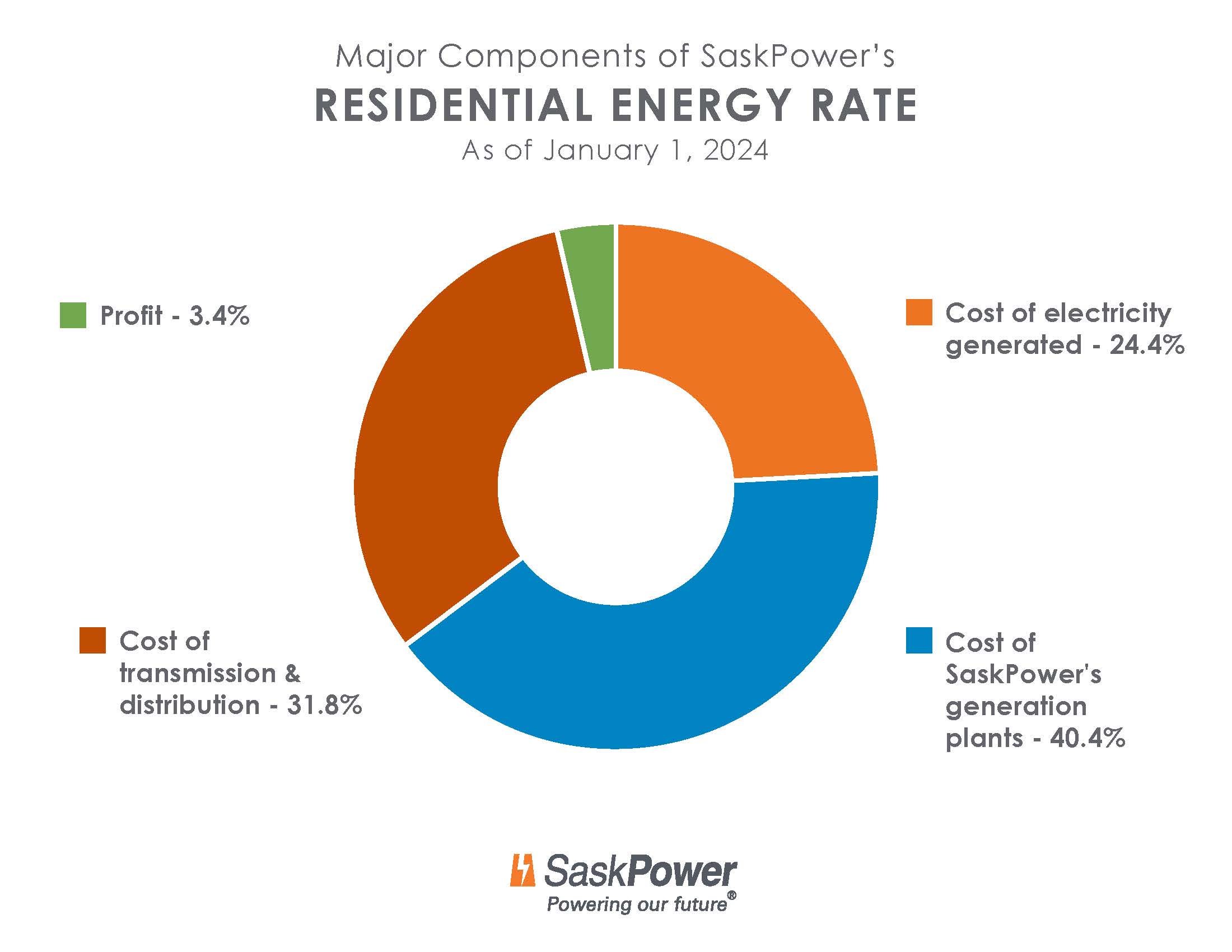
Cost of Electricity Generated
The cost to operate our power stations and infrastructure is primarily based on the cost of fuel. The cost of fuel varies over time depending on the source that’s used.
Cost of Our Power Stations
This is a fixed cost that supports the building, operation and maintenance of our power stations and facilities. The power generated is used as back-up power for net metering customers.
Cost of Delivering Power to You
We need to deliver power to your home through our power lines and poles from across the province.
Profit
A small part of the overall rate goes towards profit. This allows us to keep our business operating so we can continue to provide you power.
How to Read Your Bill
View a net metering bill to see how it displays.
Understanding the System
Knowing how your system works will help ensure you have the proper set up now and into the future.
Since renewable power can’t be easily stored, it must be used in real-time.
Any power your system can’t use, will be sent to our grid. You’ll then receive a credit. If your system isn’t generating power to meet your needs, your power will come from our grid to ensure you always have power when you need it.
First, you’ll want to track your monthly power use. You can do this by logging in or signing up for MySaskPower. Using this information, work with your vendor to determine the size and cost of a system. The maximum size a system can be is 100 kilowatts (kW).
We suggest that you analyze when you use the most power. This includes both time of day and time of year and be sure to factor this in. Also, consider future power use and needs when determining the size of your system (i.e. electric vehicles).
Make sure you consider the following and work with an expert where appropriate:
- Cost of installation for solar panels and other renewable sources
- Lifespan, solar panel maintenance and other upkeep of equipment
- Feasibility of the project for your property
- Condition of building structure
- Shingles
- Obstructions (ie. chimneys, roof vents, power lines)
- Pitch of roof
- Extra home insurance
- Applicable grants or incentives
- Getting multiple quotes
- Have an interconnection study done with a quote from us before buying any equipment
- Verify that the information you’ve been provided with aligns with the existing SaskPower net metering program. If you’re not sure, please email us.
Being able to connect new generation to the grid depends on factors such as:
- Your location
- Existing infrastructure
- Size of the proposed system
We encourage you to wait until we’ve finished our interconnection study. It may help you avoid unexpected costs or project changes. Systems that are appropriately sized for your energy needs are often the simplest and most cost-effective to connect.
Using a storage system like a battery or powerwall allows you to store extra power you generate. You can use that power when your solar system isn’t producing or during an outage. A vendor who offers storage solutions is the best place to get more information.
When your home is more efficient, you’ll get the most from your system. We recommend exploring our tools and resources before installing your system:
Environmental Factors
Weather can impact your power use and generation. For example, if you have a solar power system, Saskatchewan’s dark, snowy winters could impact your power use and generation.
During winter, the demand for power is highest between 5 and 9 pm. That could result in less credits for generation and increase your power use from our grid.
Solar panel performance will also vary based on the direction and slope of your roof and how its impacted by sun and snow at different times of the year.
Understanding the Impacts of Outages
During a power outage, your system would shut down. For backup power, consider a storage system.